
Introduction
Every dairy farmer in India knows the biggest headache of livestock farming isn’t the milking — it’s the feeding. Green fodder is abundant during the monsoon and completely scarce during summer and peak winter. This gap is exactly what corn silage solves. It is fermented, whole-plant maize fodder that stays fresh, nutritious, and ready to feed for months — even years — after it is made.
This guide covers everything an Indian dairy farmer, cattle owner, or fodder entrepreneur needs to know about corn silage in 2026: what it is, how it’s made, how much it costs, how much to feed, and how it compares to traditional green fodder.
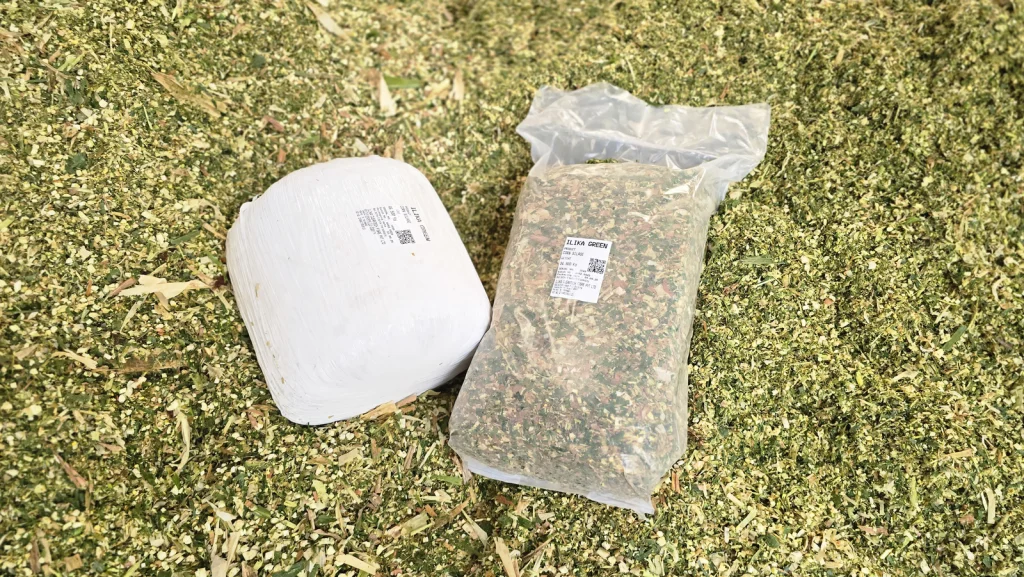
What Is Corn Silage?
Corn silage (also called maize silage) is fodder made by chopping the entire green maize plant — stalk, leaves, cob, and grain — and packing it tightly in an airtight environment (a pit, bunker, bag, or wrapped bale) so it undergoes controlled fermentation. This process, called ensiling, converts plant sugars into lactic acid and other organic acids, which lowers the pH and preserves the fodder in a moist, nutrient-rich state without spoiling.
Unlike hay, which is preserved by drying, silage is preserved by fermentation while the crop is still moist — usually with 60–70% moisture content at the time of harvest. This is why silage retains far more of the plant’s original nutrients, energy, and palatability compared to sun-dried fodder.
Maize is considered the “gold standard” crop for silage worldwide because of its high starch content, easy fermentability, and excellent yield per acre — all qualities that make it especially attractive for Indian dairy and dairy-cooperative farmers dealing with erratic fodder availability.
Why Indian Dairy Farmers Are Switching to Corn Silage
Fodder scarcity is a structural problem in India. Feeding accounts for roughly 65–70% of the total cost of running a dairy operation, and green pasture land is shrinking steadily across the country due to urbanization and land fragmentation. Government bodies spend heavily every year on fodder purchase and subsidies for green fodder storage, yet shortages during the lean season (April–June and parts of winter) remain common because traditional pit-digging methods are labour-intensive and difficult to scale.
Corn silage directly addresses this gap:
- Year-round availability — silage made in October can still be fed in June, unlike green fodder that wilts within a day.
- Higher energy density — silage delivers more digestible fiber and starch per kg than dry fodder like wheat straw.
- Lower transport and storage loss — once sealed, silage loses very little nutritional value over months.
- Space efficient — one acre of maize can be converted into enough silage to feed several animals for an extended period, something dry fodder storage cannot match.
- Consistent nutrition — silage quality doesn’t fluctuate season to season the way fresh-cut grass does.
This is also why packaged, ready-to-use corn silage — sold in 25 kg, 50 kg, and larger bales or bags — has become a fast-growing product category on platforms like IndiaMART, with dozens of Indian manufacturers now supplying states such as Maharashtra, Gujarat, Punjab, Rajasthan, Madhya Pradesh, Karnataka, and Tamil Nadu.
Nutritional Value of Corn Silage
Corn silage is prized as a high-energy forage because it supplies both digestible fiber and fermentable starch, both of which are essential precursors for microbial fermentation and volatile fatty acid (VFA) production in the rumen. Research has shown that well-preserved, good-quality corn silage can raise milk yield by 5–10% compared to poorly fermented silage, largely because it promotes better rumen health and microbial efficiency.
| Parameter | Typical Range |
|---|---|
| Moisture content | 60–70% |
| Dry matter (DM) | 28–40% |
| Crude protein | 6–12% |
| Crude fiber | 20–25% |
| Crude fat | 1–3% |
| pH (well-fermented) | ~3.8–4.2 |
| Shelf life (sealed) | 6 months – 2 years |
During fermentation, lactic acid bacteria break down plant sugars into acetic, propionic, lactic, and butyric acids. This acidity is what preserves the silage — the same principle behind curd, pickles, and sauerkraut. Some of these fermenting bacteria (like Lactobacillus species) also generate beneficial compounds such as folate and vitamin B12, adding a small nutritional bonus beyond the base forage value.
One important caveat: silage that is poorly packed or improperly sealed can develop mould and mycotoxins, which negatively affect herd health rather than support it. Quality control during making and storage is therefore non-negotiable.
Corn Silage vs Traditional Green Fodder
| Factor | Corn Silage | Fresh Green Fodder |
|---|---|---|
| Availability | Year-round, stored | Seasonal only |
| Shelf life | 6 months–2 years (sealed) | 1–2 days |
| Nutrient retention | High, stable | Drops quickly after cutting |
| Storage space needed | Compact (pit/bag/bale) | Requires continuous cropping |
| Labour needed | One-time (harvest + ensiling) | Daily cutting and transport |
| Cost per kg (India, 2026) | ₹5 – ₹10/kg (bulk) | Variable, often similar or higher in lean season |
| Milk yield impact | Can increase milk yield 5–10% when good quality | Depends on season and quality |
How Corn Silage Is Made — Step-by-Step Process
Here is the practical process followed by small and mid-scale Indian farmers:
1. Choose the Right Maize Variety and Sowing Density Fodder-purpose maize hybrids are sown at a higher plant density than grain-purpose maize, since the goal is maximum green biomass, not just cob yield.
2. Harvest at the Right Maturity Stage Maize for silage is ready roughly 75–90 days after sowing, at the “milk line” or dough stage — when the kernel is about 50% starch and the plant still has 60–65% moisture. Harvesting too early reduces energy content; harvesting too late makes the crop too dry to ferment properly. A simple field test: squeeze a stalk — if it feels only slightly moist rather than dripping wet, it’s usually ready.
3. Wilt if Needed If moisture is too high, the cut crop is left to dry in the sun for 2–5 hours before chopping.
4. Chop the Crop The whole plant is run through a chaff cutter and cut into pieces of roughly 1–2 inches (13–20 mm). Shorter, uniform chop length helps achieve tighter compaction and better air exclusion — both of which are critical to fermentation quality.
5. Fill the Silo Quickly The chopped material is loaded directly into a pit, bunker, or storage bag in layers of about 1–1.5 feet at a time. Speed matters here — the faster the silo is filled and sealed, the less oxygen exposure the crop gets, and the better the final silage quality. Industry guidance recommends closing the bunker within roughly 16 hours of starting to fill it wherever possible.
6. Compact to Remove Air Each layer is pressed firmly — by tractor for large volumes, or manually for small pits — to squeeze out trapped air. Poor compaction is one of the most common causes of spoiled silage in India, since oxygen pockets allow mould and undesirable bacteria to grow instead of the beneficial lactic acid bacteria.
7. Seal Airtight Once filled, the silo is covered with UV-stabilised plastic sheeting and weighed down with soil, tyres, or sandbags to keep it completely airtight. Corners and edges where machinery can’t press properly need extra manual compaction and sealing care.
8. Let It Ferment Anaerobic fermentation begins within about 48 hours of sealing and is largely complete within two to three weeks, though many farmers leave the silo undisturbed for at least a month before opening it for feeding.
9. Store and Feed A well-sealed silo can preserve fodder in good condition for two to three years, though most Indian dairy farmers use their stock within a year. Once opened, silage should be fed out steadily and the exposed face kept covered to prevent air from re-entering and spoiling the remaining stock.
Types of Silos Used in India
- Trench/Pit Silo — A pit dug into the ground; suitable when land is available and volume is large. Most economical for small and medium dairy farmers.
- Bunker Silo — Built partly or fully above ground with retaining walls; allows tractor compaction and is common for cooperative or larger-scale operations.
- Bag Silage — Chopped fodder is packed into heavy-duty plastic bags (commonly 25–100 kg). Popular with small farmers because it requires no digging or construction.
- Bale Silage — Fodder is baled and wrapped tightly in UV-stabilised plastic film, creating a “silage sausage.” Increasingly common in India through both imported and indigenous baling machines, and well suited for farmers who want to sell surplus silage commercially.
- Tower Silo — Rare in India due to cost, but used in some large mechanised dairy operations.
Corn Silage Price in India (2026)
Corn silage prices vary depending on moisture content, packaging, dry matter percentage, and whether it’s sold loose, bagged, or baled. Based on current supplier listings across India:
| Product Type | Approx. Price per Kg |
|---|---|
| Bulk pit/loose silage | ₹5 – ₹7 |
| Bagged silage (25–50 kg) | ₹6 – ₹8.50 |
| Baled silage (35–100 kg) | ₹7 – ₹10 |
| Silage inoculants/culture | ₹55 – ₹150 |
Prices are generally lower in states with strong maize cultivation belts (Maharashtra, Karnataka, Madhya Pradesh, Punjab) and rise slightly for premium or organic-certified silage. Buying in bulk directly from a manufacturer, rather than a retailer, typically brings costs down significantly for dairy farms with 10+ animals.
How Much Silage Should You Feed Per Animal?
A high-yielding crossbred cow or buffalo typically requires 20–25 kg of silage per day, depending on body weight and milk production stage. For a full year of feeding one animal, that works out to roughly 9 tons of silage — around eighteen 500 kg bags.
For planning purposes:
- 10-cow farm, 100-day lean season gap: approximately 20–25 tons of silage needed.
- Land requirement: roughly half an acre (about 20,000 sq. ft) of maize can supply one animal’s silage needs for a full year; 10,000 sq. ft is generally enough for six months.
- Storage density: a well-compacted silo typically holds 600–700 kg of silage per cubic meter.
Silage is usually fed as part of a Total Mixed Ration (TMR), combined with dry fodder like wheat straw and a concentrate mix, rather than as the sole feed — this balances protein, energy, and fibre for optimum digestion and milk output.
Benefits of Corn Silage for Dairy Farmers
- Higher and more stable milk yield through consistent energy supply.
- Reduced dependency on the monsoon and seasonal fodder cycles.
- Lower feed cost per litre of milk once volumes scale up.
- Better rumen health, with lower risk of acidosis when silage quality is properly managed.
- New income opportunity — many farmers now sell surplus silage as a side business, especially bagged or baled silage, given rising demand from neighbouring dairy farms.
- Environmental benefit — maize grown for silage also contributes to better soil carbon retention compared to leaving land fallow.
Common Mistakes to Avoid
- Harvesting too early or too late — both reduce nutrient and starch content.
- Chopping too coarsely — prevents proper compaction and traps air pockets.
- Delaying silo sealing — every extra hour of air exposure invites spoilage bacteria.
- Poor compaction at corners and edges — a frequent cause of localized mould, especially where tractor wheels can’t reach.
- Using torn or low-quality plastic sheeting — allows air and rainwater ingress, ruining large sections of silage.
- Opening silage without a feeding plan — once opened, the exposed face should be used steadily and re-covered, or the remaining stock deteriorates quickly.
Government Support and Subsidy Schemes
Fodder development, including silage-making infrastructure and baling machinery, is supported under various central and state government livestock and fodder development schemes in India. Coverage and subsidy percentages vary by state and change periodically, so farmers should confirm current eligibility, application windows, and required documents (land ownership papers, soil health card, bank details) with their local Krishi Vigyan Kendra (KVK) or state agriculture/animal husbandry department before applying.
Frequently Asked Questions (FAQs)
Q1. What is corn silage used for? Corn silage is used as a preserved, high-energy fodder for dairy cattle, buffaloes, goats, sheep, and beef cattle, especially during periods when fresh green fodder is unavailable.
Q2. How long does corn silage last after opening? A sealed, well-made silo can preserve silage for six months to two to three years. Once opened, it should be fed out within a few weeks while keeping the exposed face covered to prevent spoilage.
Q3. Is corn silage good for cows and buffaloes? Yes. Corn silage is one of the most widely recommended forages for dairy cattle and buffaloes because of its high energy, digestible fibre, and palatability, and it can improve milk yield when fed as part of a balanced ration.
Q4. What is the price of corn silage in India? As of 2026, corn silage generally costs between ₹5 and ₹10 per kg in India, depending on moisture content, packaging (loose, bagged, or baled), and whether it’s bought retail or in bulk from a manufacturer.
Q5. How much land is needed to grow silage maize for one cow? Roughly half an acre of maize can provide enough silage to feed one high-yielding cow or buffalo for a full year; a quarter of that area covers about six months.
Q6. What is the difference between hay and silage? Hay is preserved by drying the crop until it’s nearly moisture-free, while silage is preserved by fermenting the crop at 60–70% moisture. Silage generally retains more of the original plant’s nutrients and is more palatable to livestock.
Q7. Can silage be made without a tractor? Yes. Small farmers commonly make silage using manual chopping (chaff cutter) and hand-pressing in pits or plastic bags, though tractor compaction speeds up the process and improves consistency for larger volumes.
Q8. Why does silage sometimes smell bad or spoil? Poor compaction, delayed sealing, torn plastic covering, or harvesting at the wrong moisture level allow air and undesirable bacteria (like clostridia) into the silage, producing a foul, rancid-butter smell instead of the mild, sour smell of good lactic acid fermentation.
For any help or assistance feel free to contact us.